The Quiet Freedom of Simply Being
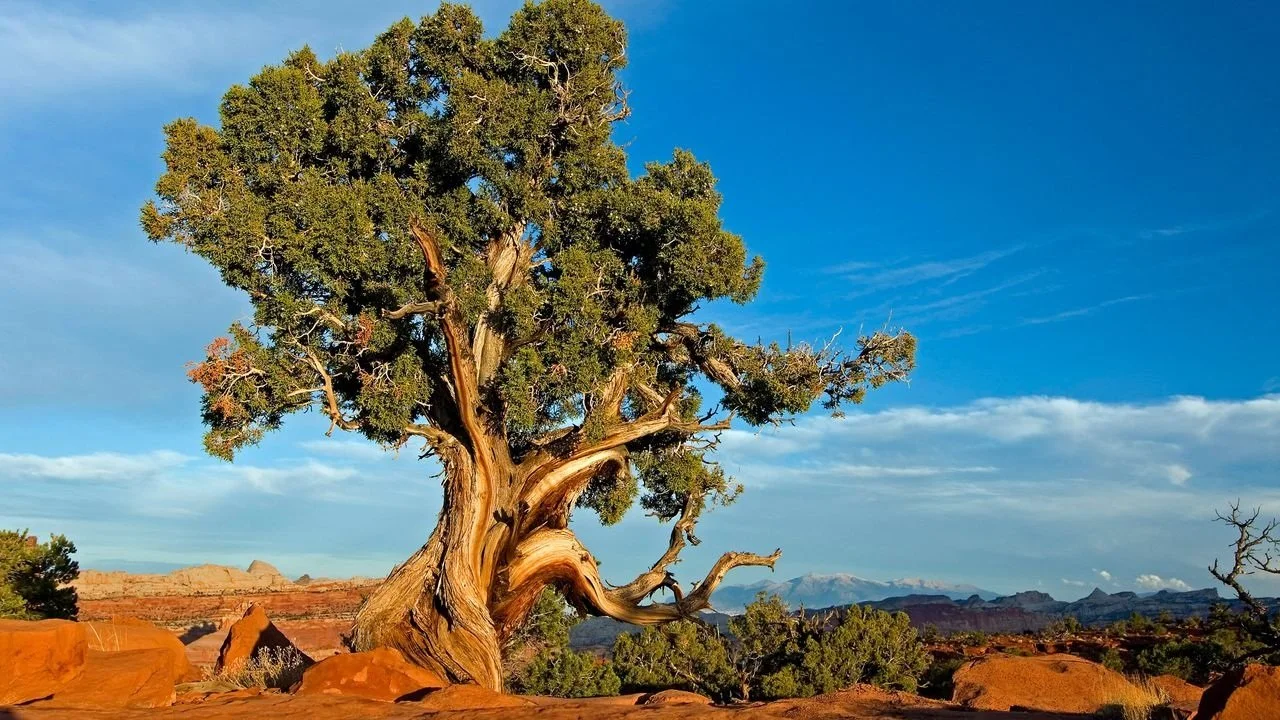
There is a juniper tree growing in the desert of Utah that may be hundreds of years old. It is not particularly straight. Its branches twist in directions that seem to make little sense, and portions of its trunk look as though they have been dead for decades. It grows in rocky soil, where water is scarce and the summers are unforgiving. A person looking for lumber would probably walk right past it.
But the tree is alive.
That alone is remarkable. Some Utah junipers survive for centuries in places where most of us would struggle to keep a garden alive for a week. Their roots reach through the dry ground in search of water. When drought becomes severe, they can stop supplying certain branches, allowing part of the tree to die so the rest can continue. The dead wood remains, sometimes for years, becoming part of the tree's unmistakable shape.
I first began thinking about this tree while listening to an old Daoist story from Zhuangzi. A carpenter comes upon an enormous tree and declares it worthless. Its wood is no good for boats, furniture, or anything else he knows how to make. Later, the tree visits him in a dream and challenges the assumption behind his judgment. Trees that are useful to carpenters are cut down. Its supposed uselessness has allowed it to live.
I have been thinking about that carpenter ever since.
We live in a world full of carpenters. Not necessarily cruel people, but people who have learned to measure everything by what it can produce. We do it to one another, and perhaps more often, we do it to ourselves. We want to be competent, needed, admired, productive. We want someone to look at us and say, “Now there is a person who is useful.” And when we cannot meet that expectation, something inside us begins to wonder whether we matter at all.
But the carpenter is not the only one who encounters the tree.
A bird sees something entirely different. The crooked branches offer a place to build a nest. The dense foliage offers protection from the weather. The juniper's small, berry-like cones provide food. Beneath it, the soil is held in place and other forms of life find shelter. What the carpenter dismisses as worthless may be indispensable to a bird.
Both are looking at the same tree.
That is where I think the story becomes larger than the familiar lesson that being useless can keep you safe. The juniper is not merely escaping the carpenter's saw. It belongs to an entire world the carpenter has failed to notice. Its purpose cannot be measured by what one man wants to make from it.
And the tree does not know any of this.
It is not trying to impress the birds. It does not wake up determined to become a better source of shade. It is not worried that another tree might have straighter branches or greener foliage. It is simply a juniper, living the life available to it in a difficult place. And because it lives, other things are able to live as well.
I find myself thinking about Ruth in the Old Testament. She is a widow in a foreign land, trying to survive and care for Naomi. She goes into a field and gathers grain left behind by the harvesters. There is nothing glamorous about the scene. She does not know the generations that will follow her or the place her name will occupy in the biblical story. She is simply being faithful to the person beside her, doing what the day requires.
The larger purpose of her life is invisible to her.
Perhaps the larger our purpose, the less likely we are to recognize its full reach. We are usually too close to our own lives to see all the people who find shelter there. We know our disappointments, our unfinished work, our awkward words, and the things we wish we had done differently. We seldom know what someone else has received from our presence.
Jesus says in John 15 that those who abide in him bear much fruit. I have come to appreciate the order of those words. The instruction is not to obsess over fruit. It is to abide. The fruit follows from the life. That seems to me very close to what the juniper has been teaching me. There is a difference between living so that we can prove our usefulness and living so fully that usefulness emerges without our having to chase it.
And then there are the scars.
We spend a remarkable amount of energy hiding ours. We learn to cover our insecurities with competence, our fears with certainty, and our disappointments with carefully managed appearances. We want to look like a tree that has never experienced a drought. Yet the juniper makes no attempt to disguise its dead branches. Neither does it display them as medals. They are simply there. The places where it has endured and adapted have become part of its shape.
Perhaps healing does not always make us look as though nothing happened. Perhaps healing becomes part of our shape.
That thought reminds me of Jung's shadow: the parts of ourselves we would rather not acknowledge. The frightened child who still wants approval. The irritation that sometimes hides a fear of failure. The need to appear capable even when we are exhausted. We may spend years trying to cut those things out of sight. But understanding them may be more important than pretending they were never there. We do not have to celebrate every wound to stop being ashamed of having been wounded.
The juniper also knows something about letting go. During drought, it cannot sustain every branch. It releases what it can no longer support and keeps living. That is not the same as saying every painful loss is necessary or good. It is simply a reminder that survival sometimes requires us to stop pouring ourselves into what cannot continue as it was.
Not long ago, while walking, I found a scattering of baseball cards beside the road. I picked up the ones I could reach and left a few farther down the hill. When I got home, I counted fifty-five. The next day I found the box: it had held sixty. I had left five behind. I was about to turn fifty-five, and the coincidence stayed with me. I do not need to turn it into a prediction to appreciate the image. I carried what I could, left what I did not need to retrieve, and continued walking.
I wonder whether the juniper has been doing something like that for centuries.
It keeps its roots. It releases a branch. It carries its scars. It feeds a bird. It shelters a nest. It grows slowly in a place that looks almost impossible for life, and it asks no one to approve of the way it grows.
Maybe that is what I find so beautiful about it. Not that it has discovered some secret method for becoming useful. Not even that it has survived so long. It is that its life is larger than any single judgment of its worth.
The carpenter sees a bad table. The bird sees a home.
The juniper is neither trying to be a table nor trying to be a home.
It is simply living.
And somehow, that is enough.
